How to Read UFC Odds and Prediction Markets: A Clear Guide
Last updated: May 2026 · 8 min read
UFC odds and prediction market probabilities express the same underlying information — likelihood of an outcome — but in different formats that serve different purposes. Understanding both, and how to convert between them, gives a clearer picture of what the market actually thinks about any given fight.
This guide explains how UFC odds work, how prediction market probabilities differ from bookmaker odds, and how to extract useful information from both systems for understanding MMA outcomes. It is not a guide to gambling — it is a guide to reading probability signals in a sport defined by its unpredictability.

Quick Answer
UFC odds express implied probability with a bookmaker margin built in. American odds of -200 imply approximately 67% win probability (after removing the margin). Prediction market probabilities express the same concept more cleanly — a 65% probability means the market collectively assesses that outcome as occurring 65% of the time. The key difference: bookmaker odds include a systematic commercial margin; prediction market prices do not.
American Odds: How They Work
UFC fights are typically expressed in American odds format — a system that uses positive and negative numbers to indicate the favourite and underdog. Understanding this format is the first step to reading any fight probability.
American Odds Format Explained
| Odds | Meaning | Implied Probability |
|---|---|---|
| -300 | Heavy favourite | ~75% (before margin) |
| -200 | Clear favourite | ~67% (before margin) |
| -150 | Moderate favourite | ~60% (before margin) |
| -110 | Slight favourite | ~52% (before margin) |
| +150 | Moderate underdog | ~40% (before margin) |
| +300 | Heavy underdog | ~25% (before margin) |
Implied probabilities are before margin removal. Actual probability is slightly lower for the favourite and higher for the underdog once the bookmaker’s margin is extracted.
Converting American Odds to Probability
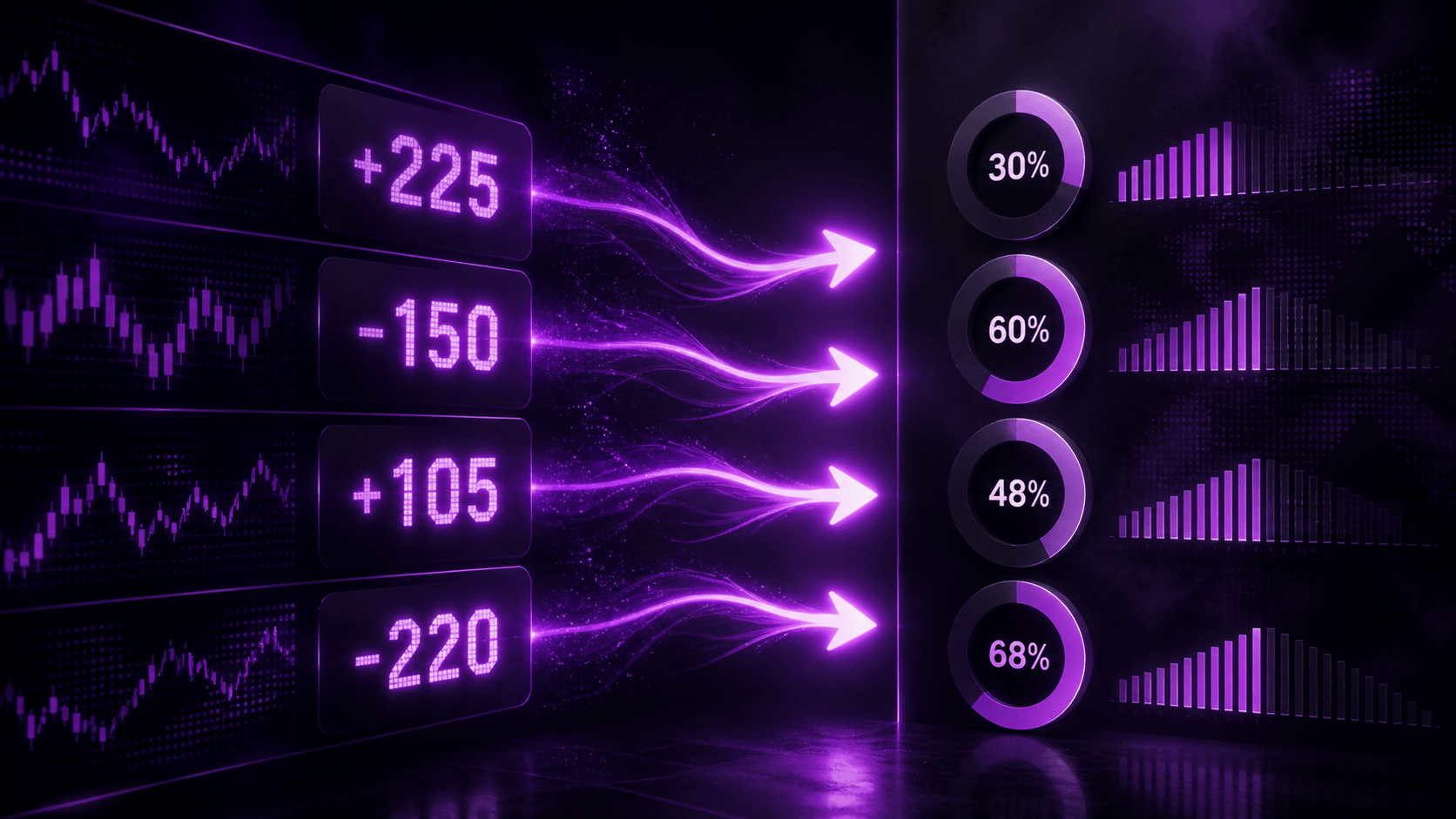
The formula for converting American odds to implied probability is straightforward:
For favourites (negative odds): Probability = |Odds| ÷ (|Odds| + 100). So -200 gives 200 ÷ 300 = 67%.
For underdogs (positive odds): Probability = 100 ÷ (Odds + 100). So +200 gives 100 ÷ 300 = 33%.
The Bookmaker Margin: Why Odds and Probability Differ
The most important concept for reading UFC odds accurately is the bookmaker’s margin — also called the vig, juice, or overround. This is the systematic profit mechanism built into odds that means the two sides of a fight always add up to more than 100% implied probability.
Example: A fight priced at -200 / +160 converts to 67% implied probability for the favourite and 38.5% for the underdog — totalling 105.5%. The 5.5% overage is the bookmaker’s margin. The actual probability estimates the bookmaker is using might be 64% / 36% — the margin shifts both sides toward 50% to protect their exposure.
This is a critical distinction: the raw implied probability from bookmaker odds overstates the favourite’s probability and understates the underdog’s probability. To get the “no-vig” probability — the bookmaker’s actual assessment — the margin needs to be removed. Various online calculators perform this calculation instantly.
How Prediction Markets Differ From Bookmaker Odds
Prediction markets express fight probability differently — and more cleanly. A prediction market showing 65% for Fighter A means the collective assessment is 65%, with no commercial margin embedded in the number. This makes prediction market probabilities more directly readable as probability estimates than bookmaker odds.
They also aggregate information differently. Bookmaker odds are set by risk managers balancing their exposure. Prediction markets aggregate the views of many participants acting on their own analysis. The latter tends to produce better-calibrated probabilities in high-information environments — which major UFC fights, with extensive public analysis and media coverage, typically are.
For a detailed explanation of how prediction markets produce their probability estimates and what the research shows about their accuracy, see how accurate are prediction markets.
What the Odds Don’t Tell You
Limitations of UFC Odds as Probability Signals
- Method of victory — odds express win probability, not how the win occurs
- Round-specific outcomes — early finish vs. late decision have very different implied probabilities
- Fight quality — the odds say nothing about how competitive a fight will be
- Camp variables — injury, preparation quality, and gameplan are not in the odds
- Judge scoring tendencies — decision fights involve additional uncertainty not priced in the win odds
For all the information that odds do encode, they are ultimately a single number expressing a complex multidimensional probability. Two fights priced at -200 / +160 can have completely different underlying structures — one a stylistic mismatch, one a highly competitive clash where the favourite is simply slightly better. Understanding these limitations is part of reading UFC probability accurately.
Apply Your Analysis
Explore UFC Prediction Markets on Nexory
Nexory hosts prediction markets on UFC fight outcomes — expressed as calibrated probabilities without bookmaker margin. See how collective assessments form around major fights.
Explore Predictions on NexoryConclusion
Reading UFC odds accurately requires understanding two things: the mechanical conversion between odds format and implied probability, and the commercial margin that systematically distorts the raw numbers. Once both are understood, odds become a useful — though imperfect — probability signal.
Prediction markets offer a cleaner version of the same signal — without the margin, with better calibration in high-information environments, and with the flexibility to price a wider range of specific outcomes. For MMA specifically, where upsets are structurally common and the 35% scenario materialises with significant frequency, understanding probability correctly is more important than in most other domains.
Frequently Asked Questions
What does -150 mean in UFC odds?
-150 indicates the fighter is a moderate favourite. The implied probability before margin removal is approximately 60%. After removing the typical bookmaker margin, the actual probability estimate is closer to 57–58%. The fight is competitive but clearly favours one fighter.
Why do UFC upsets happen so often even when one fighter is heavily favoured?
Even at -300 (implied 75% probability), the underdog wins roughly 25% of the time. Across a full UFC card with multiple fights, statistical probability means multiple upsets occur regularly. MMA’s outcome structure — where one punch or submission from a losing position can end a fight — amplifies the frequency of results that contradict the probability-weighted expectation.
Are prediction markets more accurate than bookmaker odds for UFC fights?
Prediction markets tend to produce better-calibrated probability estimates because they aggregate diverse information sources without a commercial margin. For high-profile UFC fights with extensive public analysis and media coverage, prediction markets consistently outperform single-source expert forecasts. For lower-profile fights with limited public information, the advantage is smaller.