OpenAI vs Google: Who Will Lead the AI Race in 2026?
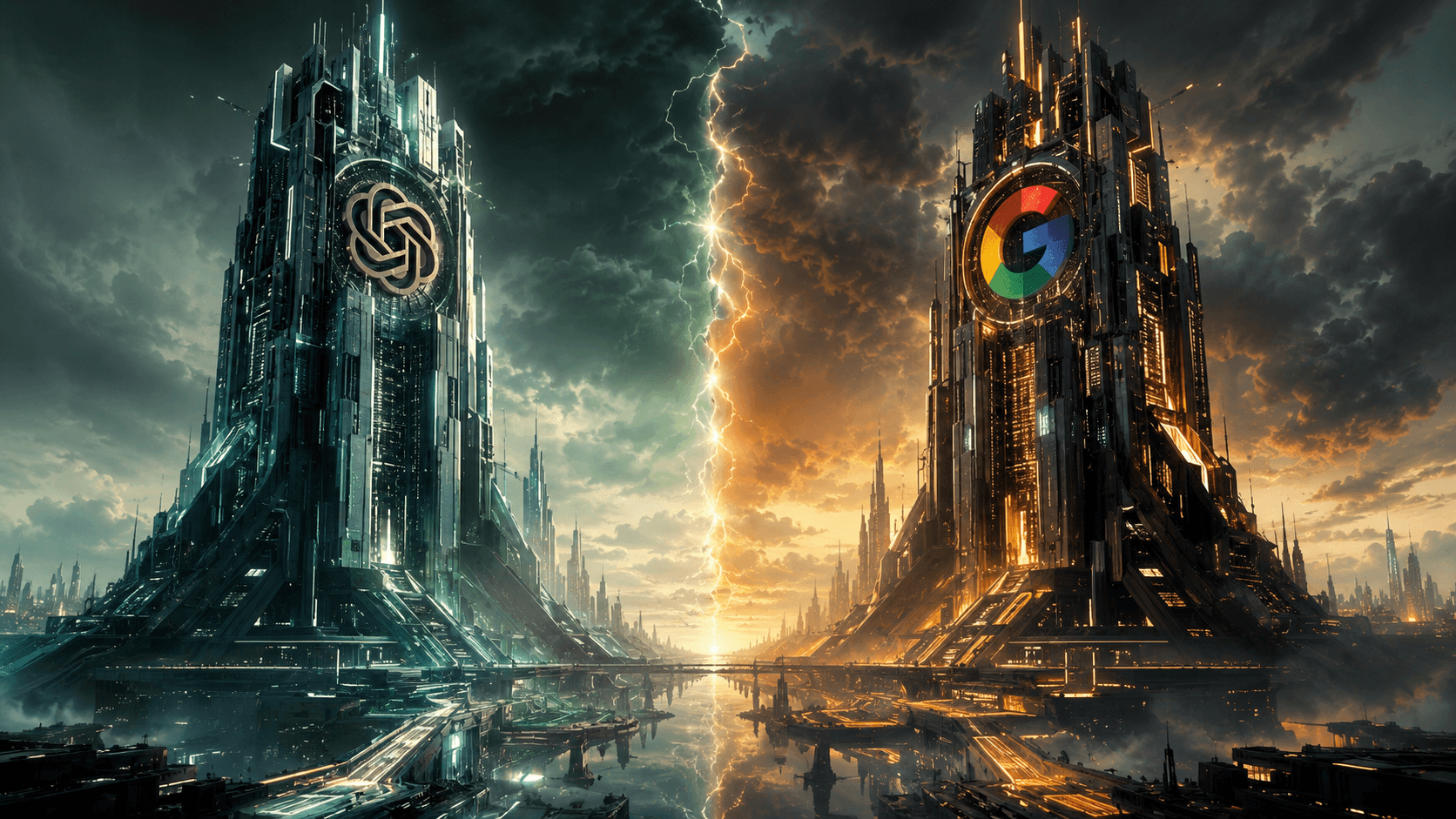
OpenAI vs Google: Who Will Lead the AI Race in 2026?
Category: Technology Forecasts | Reading time: ~9 min
The contest between OpenAI and Google is the defining corporate rivalry in artificial intelligence. One company invented the transformer architecture that underlies most modern AI — and then watched a startup use it to build the fastest-growing consumer application in internet history. The other is attempting to reclaim its position as the world’s leading AI organisation while managing one of the most complex product portfolios in technology.
In 2026, this contest is genuinely unresolved. Both companies have frontier capabilities. Both have structural advantages the other lacks. And both are making strategic bets whose outcomes are uncertain.
QUICK ANSWER
In 2026, OpenAI leads on consumer mindshare and developer ecosystem. Google leads on distribution infrastructure and multimodal capability. Neither has established definitive dominance. The competitive outcome will hinge on enterprise adoption, the economics of AI inference at scale, and which company’s strategic partnerships prove most durable. Forecasters assign meaningful probability to both outcomes — and to neither winning outright.
OpenAI’s Structural Advantages
OpenAI’s first-mover advantage in consumer AI has translated into durable brand recognition that competitors have not been able to overcome. When most people think “AI chatbot,” they think ChatGPT — and that default association has direct commercial value.
The Microsoft partnership is OpenAI’s most important structural asset. Microsoft’s $13 billion investment has been deployed across Azure infrastructure, Office 365 integration, GitHub Copilot, and enterprise sales relationships. This gives OpenAI access to Microsoft’s enterprise customer base — tens of thousands of organisations globally — without needing to build those relationships from scratch.
OpenAI’s API business is also substantial. A large share of AI-powered applications built by third-party developers run on OpenAI’s models. This creates a network effect: the more developers build on the platform, the more the platform improves, and the more attractive it becomes for new developers. Displacing an established API platform requires not just a better model, but better documentation, tooling, reliability, pricing, and support.
Google’s Structural Advantages
Google’s advantages are structural in a different sense — they are embedded in distribution at a scale that no competitor can replicate quickly. Google Search handles billions of queries per day. Gmail has over 1.8 billion users. Android powers the majority of smartphones globally. Chrome is the world’s most-used browser.
Gemini’s integration into these products gives it access to users who are not actively seeking an AI tool — they are simply using Google products and encounter AI capabilities embedded in those experiences. This passive distribution is qualitatively different from requiring a user to seek out and adopt a new product.
Google’s compute infrastructure is another key advantage. Google has been building AI-specific hardware — its Tensor Processing Units (TPUs) — for nearly a decade. This gives it cost and efficiency advantages in running AI workloads at scale that newer entrants cannot easily match.
DeepMind, now integrated into Google as Google DeepMind, brings deep research capability. DeepMind’s track record — AlphaFold, AlphaGo, Gemini — represents genuine frontier research achievement. The question is whether that research capability translates into durable product leadership.
Where OpenAI Is Vulnerable
OpenAI’s position carries significant risks. The company’s cost structure — running frontier AI models is extremely expensive — requires continued revenue growth and investment to sustain. Its dependence on Microsoft is both an advantage and a constraint: the partnership provides distribution but limits strategic independence.
OpenAI’s organisational structure has also been a source of uncertainty. The transition from a non-profit to a capped-profit model, combined with high-profile departures of senior researchers, has raised questions about long-term talent retention and governance stability.
The open-source dimension is also a risk. Meta’s decision to release powerful open-source models has eroded the capability gap between frontier closed models and freely available alternatives. If that gap continues to narrow, the commercial case for paying for API access weakens.
Where Google Is Vulnerable
Google’s challenge is the classic large-company innovation problem: an existing business that generates enormous revenue (Search advertising) creates incentives to protect that business even when disruption is coming. AI-powered search results that give direct answers reduce the click-through that generates advertising revenue — creating a structural tension between Google’s AI ambitions and its core business model.
Execution has also been a challenge. Google was slower than OpenAI to deploy consumer AI products, and its early Gemini rollout attracted criticism for quality issues. Speed of deployment matters in a competitive market where consumer habits are forming rapidly.

What Forecasters Say
The forecasting consensus on the OpenAI vs Google contest reflects genuine uncertainty. A market dominated by a single company — either one — is considered less likely than a segmented outcome where each retains strong positions in different contexts.
The scenarios most frequently discussed by forecasters are: OpenAI maintains consumer leadership while Google wins on enterprise integration; Google’s distribution advantages compound over time as Gemini becomes more capable and more embedded in Google’s product ecosystem; or a third dynamic where open-source models constrain both companies’ pricing power and neither achieves dominant margin positions.
Prediction markets on AI company outcomes in 2026 reflect wide probability distributions — consistent with genuine uncertainty rather than a clear frontrunner. The result is likely to depend on factors that are difficult to forecast: specific product decisions, enterprise sales wins, regulatory outcomes, and the pace of model improvement at each company.
The Broader Context: More Than Two Players
Framing the AI race as purely OpenAI vs Google understates the competitive landscape. Anthropic’s Claude is a genuine frontier competitor with distinct enterprise positioning. Meta’s open-source strategy is reshaping the economics of the entire market. Amazon’s investment in Anthropic and its Bedrock platform give it a significant enterprise AI position. And Chinese AI labs — operating within export control constraints — are developing capable systems that complicate the geopolitical dimension of the competition.
The AI race in 2026 is better understood as a multi-player contest with different companies leading across different dimensions — consumer reach, enterprise revenue, model capability, open-source influence, and regulatory relationships — than as a straightforward head-to-head between two companies.
For a direct comparison of the models themselves, see ChatGPT vs Claude vs Gemini: Which AI Is Winning in 2026? For the full AI landscape overview, see our AI Predictions 2026 analysis.
Conclusion
Who leads the AI race in 2026 depends on how you define leadership. OpenAI leads on consumer recognition and developer ecosystem. Google leads on distribution infrastructure. Neither has won. The competition will continue to produce genuinely uncertain outcomes — which is precisely why it is one of the most actively tracked questions in technology forecasting.
Follow the AI Corporate Race
Nexory allows users to participate in forecasting technology competition outcomes through transparent prediction markets.
Explore predictions on NexoryFrequently Asked Questions
Is OpenAI ahead of Google in AI?
OpenAI leads on consumer brand recognition and developer ecosystem. Google leads on distribution infrastructure and multimodal capability. On raw model performance, the two are competitive and rankings shift with each new release. Neither has established clear overall dominance in 2026.
Why did Google fall behind in AI?
Google was a pioneer in AI research — including the transformer architecture — but was slower to deploy consumer AI products. Organisational complexity, concern about disrupting Search advertising revenue, and the speed of OpenAI’s consumer rollout all contributed to Google losing first-mover advantage in the consumer AI market.
Who is winning the AI race in 2026?
No single company has won. The AI competitive landscape in 2026 is best understood as segmented: OpenAI leads in some dimensions, Google in others, with Anthropic, Meta, and others holding significant positions in specific markets or use cases.