UFC 2026: The Biggest Fights and What Prediction Markets Are Pricing
Last updated: May 2026 · 9 min read
2026 has delivered — or is building toward — some of the most anticipated matchups in recent UFC history. Championship fights across multiple divisions, long-awaited rematches, and potential GOAT-defining contests have shaped the year’s fight card in ways that prediction markets have actively priced since early announcements.
This article examines the most significant UFC fights of 2026, what prediction markets are saying about their outcomes, and what variables are carrying the most weight in each probability assessment. For the underlying mechanics of how MMA prediction markets form these estimates, see how UFC fight outcomes are predicted and why upsets keep happening.

Quick Answer
The most consequential UFC fights of 2026 involve the heavyweight championship situation (Jones vs. Aspinall being the highest-profile potential matchup), lightweight title developments, and women’s divisional title fights. Prediction markets assign meaningful probability to upsets in several key matchups — reflecting MMA’s structural unpredictability rather than close competitive assessments in every case. The heavyweight landscape remains the most uncertain of any major division.
How UFC Fight Markets Form and Move
UFC prediction markets open when fights are officially announced — typically 6–12 weeks before the event. Initial probabilities reflect the collective assessment of participants working from fighters’ recent records, stylistic matchup analysis, and historical precedent from similar confrontations.
From announcement to fight week, probabilities update continuously as new information enters the market. Press conference interactions, open workout observations, weigh-in results, and fight week interviews all carry information that participants act on. The weigh-in in particular — where the scale result and a fighter’s physical appearance are directly observable — often produces significant probability movement on fight day.
This continuous updating is one of the most practically useful features of UFC prediction markets: the probability at fight time reflects more information than the probability at announcement, and tracking the direction of movement from opening to close often signals more than the absolute level.
Heavyweight: The Championship Picture
The UFC heavyweight division in 2026 is defined by the Jones-Aspinall situation — two championship holders in the same division with the unification fight representing the most commercially significant and competitively anticipated heavyweight matchup in years.
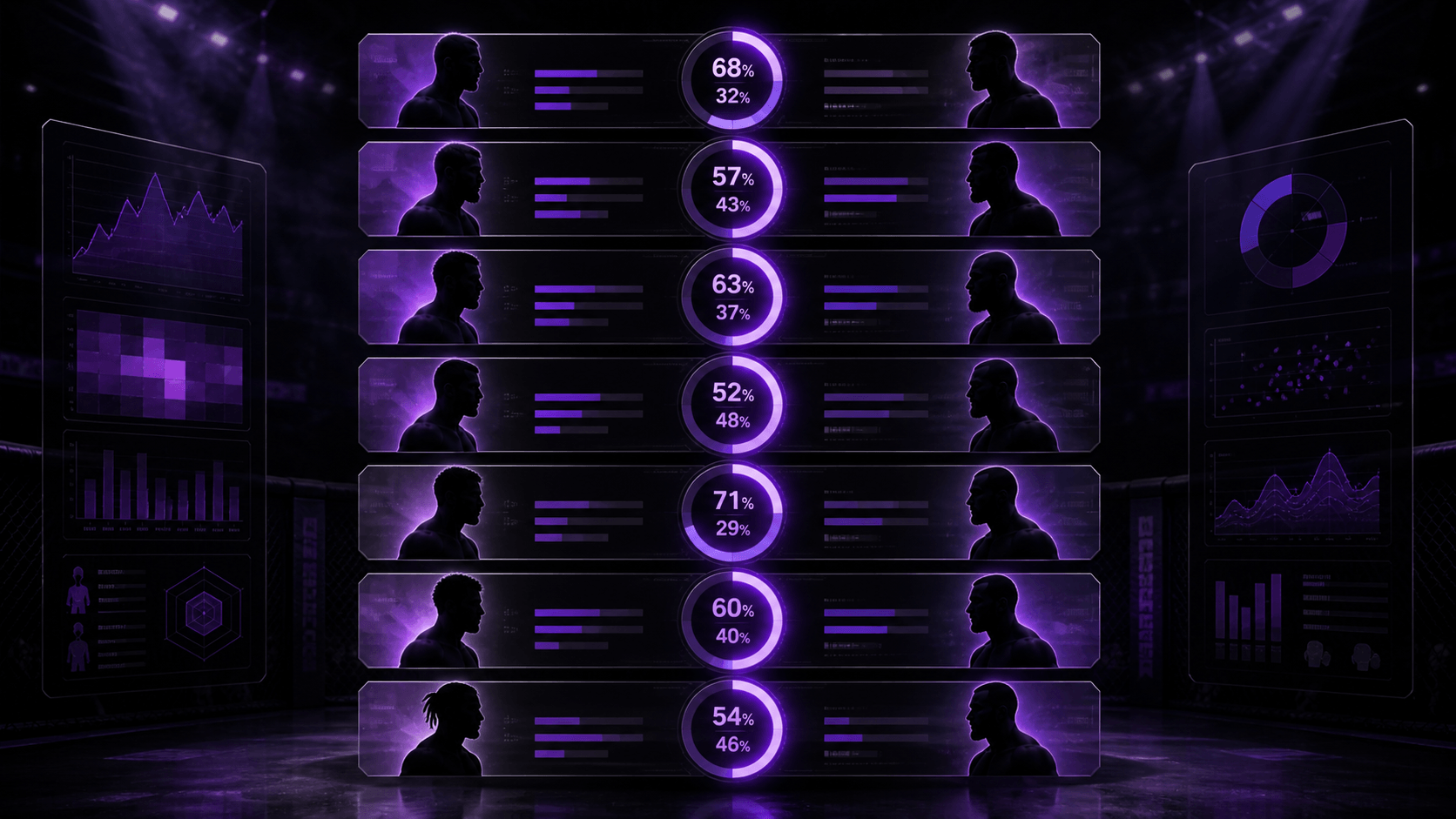
Prediction markets for this potential matchup — priced speculatively before official announcement — assign Jones approximately 55–62% probability, making it the closest competitive assessment of any Jones fight in his heavyweight era. The market reflects genuine uncertainty about which stylistic profile prevails: Jones’s wrestling, experience, and unorthodox striking versus Aspinall’s speed, power, and finishing rate.
A detailed analysis of the Jones probability picture across potential opponents is covered in Jon Jones in 2026: what prediction markets say.
Lightweight: The Most Competitive Division
The UFC lightweight division remains the deepest and most competitive weight class in the sport. Championship fights at lightweight consistently produce closer prediction market probabilities than in other divisions — reflecting the genuine quality compression among the top ten fighters, where stylistic variables matter as much as absolute ranking.
Prediction markets for lightweight title fights in 2026 show characteristic tightness — probabilities in the 55–65% range for the champion against the top contenders, with meaningful upset probability in every match. This is accurate: lightweight upsets happen with significant frequency, and the market is right to assign them meaningful probability even against established champions.
Women’s Divisions: Dominant Champions, Real Upset Risk
Women’s UFC divisions in 2026 feature a mix of established dominant champions and competitive contender landscapes. The women’s bantamweight division has historically produced the sport’s most dominant champions — fighters who have gone on record title defence streaks that would be remarkable in men’s divisions — while women’s flyweight and strawweight offer more competitive championship pictures.
Prediction markets for women’s division fights show the same structural pattern: dominant champions carry 70–80% probability in title defences, but the 20–30% upset scenarios are real and occur with sufficient frequency that they cannot be dismissed. MMA’s outcome structure — where one submission or one clean strike can end a fight regardless of round-by-round dominance — applies equally to women’s divisions.
Reading UFC Fight Card Probabilities: A Framework
How to Read a UFC Fight Card’s Prediction Markets
- 70%+ favourite — significant stylistic or quality advantage; upset possible but not likely
- 60–70% favourite — clear favourite with real competitive risk; common for top-10 fights
- 55–60% favourite — genuine competitive uncertainty; either fighter winning is plausible
- 50–55% favourite — essentially a toss-up; market sees near-equal probability
- Opening vs. closing line movement — direction of movement signals new information
- Weigh-in probability shift — visible physical condition updates the assessment
The Championship Implications of 2026’s Big Fights
Each major fight in 2026 has championship implications that extend beyond the individual result. A Jones loss to Aspinall reshapes the entire heavyweight landscape. A lightweight championship change opens the contender queue and creates new fight possibilities for the next 12–18 months. Women’s division title changes alter the entire ranking structure in ways that prediction markets for future fights need to incorporate.
This interconnection between fights is one of the most complex features of long-range UFC championship prediction — results cascade through the sport’s booking structure in ways that are genuinely difficult to model. For an overview of the divisional championship landscape and how these results could reshape it, see UFC championship prediction markets by division.
Follow UFC Fight Markets
Track Live UFC Predictions on Nexory
Nexory hosts prediction markets on UFC fight outcomes — updated in real time as fight week developments emerge. See collective probability assessments for the sport’s biggest matchups.
Explore Predictions on NexoryConclusion
2026’s UFC fight calendar offers a rich environment for prediction market engagement — championship fights across multiple divisions, high-profile individual matchups, and the heavyweight unification picture that has defined the division’s narrative for the past several years.
Prediction markets provide the most calibrated available picture of probable outcomes — distributed across realistic probability ranges that acknowledge MMA’s structural unpredictability rather than expressing false certainty. Reading these probabilities correctly, with appropriate understanding of what 60% means in practice, is the foundation for engaging with MMA forecasting usefully.
Frequently Asked Questions
How early do UFC fight prediction markets open?
Markets typically open within hours of an official fight announcement — usually 6–12 weeks before the event. Initial prices are based on fighters’ records, stylistic analysis, and historical precedent. Prices then update continuously as new information emerges through fight week.
Do UFC prediction markets include method of victory?
Yes — most prediction markets offer markets on both fight winner and method of victory (KO/TKO, submission, or decision). Method of victory markets have wider probability spreads because the outcome space is larger and the variables affecting each finish type are more numerous and harder to assess.
How does the weigh-in affect UFC fight prediction markets?
Weigh-in results are directly observable and carry significant information — a fighter who visibly struggles to make weight or appears physically depleted may see their probability drop meaningfully in the final hours before the fight. Markets respond to weigh-in information quickly because it updates the assessment of each fighter’s physical condition heading into competition.