Global Recession 2026: What Are the Odds?
Last updated: May 2026 · 9 min read
Whether a global recession materialises in 2026 is one of the most consequential open questions in macroeconomics. The answer shapes investment strategy, monetary policy, employment, and asset prices across every market — from equities and bonds to crypto and commodities. One of the most direct transmission channels is inflation — the trajectory of which in 2026 is examined in inflation forecast 2026: will it finally come down to target.
Prediction markets offer a structured way to track collective probability estimates on recession risk — aggregating the views of many participants who have genuine stakes in accuracy. This article examines what those markets currently show, what the key drivers of recession probability are, and what scenarios would push the odds in either direction.

Quick Answer
Prediction markets currently assign 25–40% probability to a US recession in 2026, with global recession probability somewhat lower given the divergent growth trajectories across major economies. The primary drivers are the lagged effects of aggressive monetary tightening, slowing consumer spending, and persistent uncertainty around trade policy. A soft landing remains the base case in most market assessments, but the probability of a harder outcome is meaningful and cannot be dismissed.
What Is a Recession and How Is It Defined?
The technical definition of a recession varies by jurisdiction. In the United States, a recession is defined by the National Bureau of Economic Research (NBER) as a significant decline in economic activity spread across the economy, lasting more than a few months. This typically involves declining GDP, rising unemployment, falling industrial production, and contracting consumer spending.
The informal “two consecutive quarters of negative GDP growth” definition is widely used but does not align exactly with the NBER’s assessment, which is why prediction markets need to specify clearly which definition they are using for resolution purposes. Markets that resolve on NBER declaration have longer time horizons given the agency’s lag in making official determinations.
Key Drivers of Recession Probability in 2026
1. Lagged Effects of Monetary Tightening
The Federal Reserve executed the most aggressive rate hike cycle in four decades between 2022 and 2023, raising rates from near zero to over 5%. The full economic effects of this tightening operate with significant lags — historically 12 to 24 months before they fully materialise in GDP and employment data.
By 2026, the cumulative effect of that tightening is working through the economy via higher mortgage rates, tighter credit conditions for businesses, and reduced consumer borrowing capacity. Whether these lagged effects produce a soft landing or tip into recession is the central question that prediction markets are pricing.
2. Labour Market Resilience
The US labour market has shown exceptional resilience through the tightening cycle. Unemployment remained historically low even as rates rose dramatically, defying traditional recession models that link aggressive rate increases to job losses. This resilience has been the primary argument for the soft landing scenario.
However, labour markets are typically lagging indicators — they remain strong until a recession is already underway, then deteriorate sharply. The question is whether the current strength reflects genuine economic durability or a temporary buffer before lagged monetary effects accumulate sufficiently to trigger layoffs.
3. Consumer Spending and Household Debt
Consumer spending has been the primary engine of US economic growth through the post-pandemic period. Excess savings accumulated during the pandemic have been largely depleted, and credit card debt has risen to record levels. Whether consumers can sustain spending levels as savings buffers thin and debt costs rise is a critical variable in 2026 recession probability.
4. Global Trade and Geopolitical Risk
Trade policy uncertainty, ongoing geopolitical tensions, and supply chain reconfiguration all create headwinds for global growth. A significant escalation in any of the major active geopolitical situations — Russia-Ukraine, US-China trade tensions, or Middle East conflicts — could trigger a confidence shock sufficient to tip an already-slowing economy into recession. The specific US recession probability, leading indicators, and why previous recession predictions failed is covered in will there be a US recession in 2026.
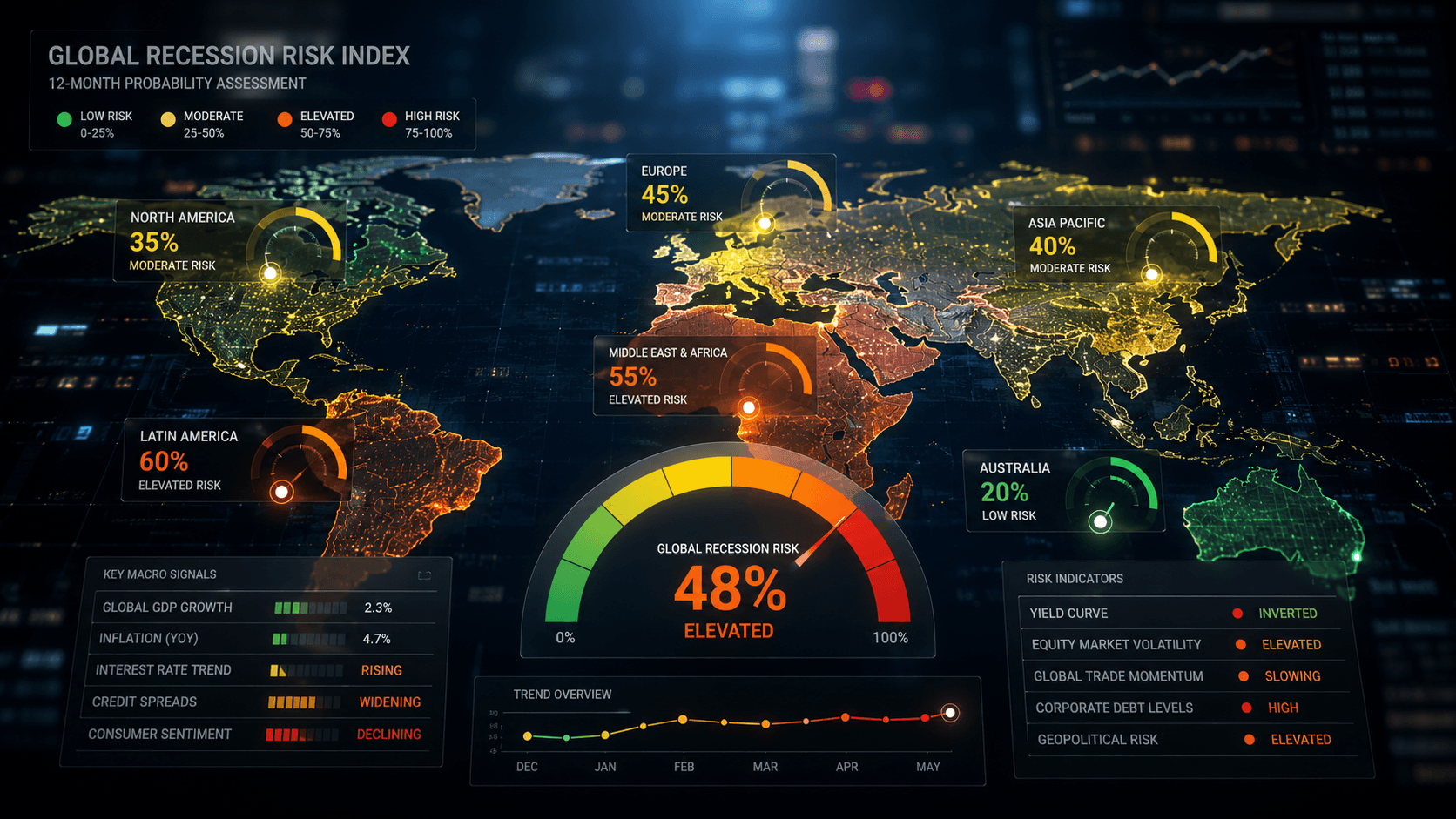
Recession Scenarios for 2026
2026 Recession Scenarios
| Scenario | Probability | Key Conditions |
|---|---|---|
| Soft landing | 55–65% | Growth slows but stays positive; Fed cuts rates in time |
| Mild recession | 20–30% | 1-2 quarters of negative growth; unemployment rises moderately |
| Severe recession | 5–10% | Significant shock — financial event, geopolitical escalation, or policy error |
What a Recession Means for Markets and Crypto
A recession scenario has direct implications across asset classes. Equities typically fall 20–40% in moderate recessions as earnings contract and risk appetite collapses. Credit spreads widen significantly. The Federal Reserve typically responds with aggressive rate cuts, which eventually benefit risk assets — but the initial phase is painful. Oil prices are a critical recession amplifier — a spike from geopolitical disruption can tip a slowing economy into contraction, as examined in oil price prediction 2026.
For crypto specifically, a recession is the primary bear case scenario. Institutional investors who now hold Bitcoin and Ethereum as risk assets would reduce exposure alongside equities. The macro chapter of the crypto market outlook for 2026 is inseparable from the recession probability question — it is the single variable that matters most. Gold’s behaviour in recession scenarios — where it often appreciates as a safe haven before Fed rate cuts restore risk appetite — is covered in gold price prediction 2026: safe haven or overextended.
Track Recession Probability
Follow Economic Prediction Markets on Nexory
Nexory hosts prediction markets on economic outcomes including recession probability, inflation trajectories, and Federal Reserve decisions. See how collective expectations are forming around the key macro questions of 2026.
Explore Predictions on NexoryConclusion
The global recession question for 2026 does not have a confident answer — and any analysis that provides one is overstating certainty. Prediction markets honestly reflect this with probability distributions that keep the soft landing as the base case while assigning meaningful probability to harder outcomes.
The most useful approach is to track the variables that matter most: Federal Reserve policy signals, labour market data, consumer spending trends, and credit market conditions. These will provide earlier warning of which scenario is materialising than any single forecast can.
Frequently Asked Questions
What is the probability of a recession in 2026?
Prediction markets currently assign approximately 25–40% probability to a US recession in 2026, making it a meaningful risk but not the base case. The soft landing scenario — where growth slows but remains positive — holds the majority of probability at 55–65%. A severe recession remains a tail risk at 5–10%.
What causes a recession?
Recessions are typically caused by a combination of factors: monetary tightening that reduces credit availability and consumer spending; demand shocks from external events like pandemics or geopolitical crises; financial system stress that restricts lending; and confidence collapses that trigger precautionary behaviour from businesses and consumers simultaneously.
How does a recession affect investment portfolios?
Recessions typically produce significant declines in equities, widening credit spreads, and falling commodity prices as demand contracts. Safe haven assets like government bonds and gold often appreciate in the initial phase. Crypto tends to fall alongside equities as risk assets are liquidated. The Federal Reserve typically responds with rate cuts that eventually benefit risk assets, but the timing of the recovery varies.