Will the Russia-Ukraine War End in 2026? Ceasefire Scenarios and What Would Need to Be True
Will the Russia-Ukraine War End in 2026? Ceasefire Scenarios and What Would Need to Be True
Category: Geopolitics | Reading time: ~9 min
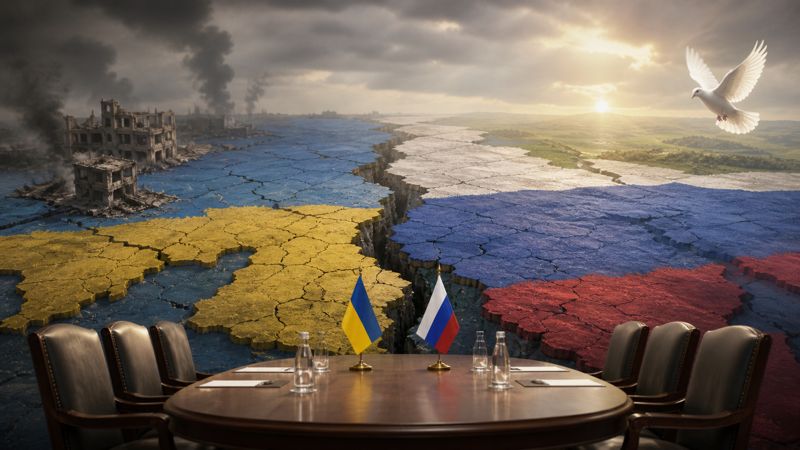
This event is among the most closely tracked in geopolitical outcomes prediction markets are watching in 2026. The Russia-Ukraine conflict, now entering its fifth year, remains one of the most consequential and genuinely uncertain geopolitical situations of the current era. Forecasters, governments, and international institutions have consistently struggled to predict its trajectory — and 2026 opens with the outcome still unresolved.
Rather than offering a single prediction, this article examines the question analytically: what are the realistic scenarios for how the conflict evolves in 2026, and — critically — what specific conditions would need to be in place for each scenario to become more likely?
This conditional framing is more useful than a simple prediction. The war’s outcome depends on an interlocking set of military, political, economic, and diplomatic variables — any of which can shift the trajectory significantly.
Quick Answer
A complete resolution of the Russia-Ukraine conflict in 2026 remains unlikely, though not impossible. The more probable near-term scenarios involve some form of ceasefire or frozen conflict rather than a negotiated peace settlement. Each scenario depends on specific conditions — military stalemate depth, Western support levels, domestic political pressures in both countries, and the role of third-party mediators — none of which are currently settled.
The Current State of the Conflict
As of 2026, the front lines of the conflict have remained broadly stable for an extended period, with neither side able to achieve decisive breakthrough despite significant offensive operations. Russia has maintained pressure across multiple sectors while Ukraine has continued to demonstrate resilience in defence and periodically launched operations aimed at disrupting Russian logistical capabilities.
The conflict has settled into what military analysts describe as a war of attrition — a phase characterised by resource competition, industrial capacity, and the sustainability of external support, rather than rapid territorial change. This attrition dynamic is itself a key driver of ceasefire probability: when both sides face sustained costs without decisive progress, the conditions for negotiation become more relevant.
The Four Scenarios
Scenario 1: Negotiated Ceasefire
What it looks like: Both sides agree to halt active military operations along current or adjusted front lines, with monitoring mechanisms in place. This does not resolve the underlying territorial or political dispute — it pauses the fighting.
What would need to be true: A ceasefire requires both parties to conclude that continued fighting offers worse expected outcomes than stopping. For Russia, this likely requires either resource exhaustion or sufficient diplomatic pressure from China — currently its most important partner. For Ukraine, it requires either battlefield exhaustion or a shift in Western support making continued resistance unsustainable. Additionally, a credible third-party mediation framework would need to emerge that both sides can accept without appearing to capitulate domestically.
Current probability signals: Sporadic ceasefire discussions have emerged through various channels. Their consistency and specificity remain limited, suggesting the conditions are not yet fully in place on either side.
Scenario 2: Frozen Conflict
What it looks like: Active hostilities de-escalate without a formal ceasefire agreement. Front lines stabilise de facto. Both sides maintain positions but reduce the pace of large-scale offensive operations. The conflict neither ends nor formally continues at high intensity — it becomes chronic.
What would need to be true: Mutual exhaustion without sufficient diplomatic framework for formal ceasefire. This is historically a common trajectory for conflicts that lack a clear military winner. The Korean Peninsula conflict, Cyprus, and several post-Soviet frozen conflicts provide historical precedents. It requires no agreement — only mutual reduction in the capacity or willingness to sustain high-intensity operations.
Current probability signals: The attrition dynamics currently visible are consistent with frozen conflict conditions developing. Resource constraints on both sides, combined with the absence of a clear diplomatic framework, make this scenario the one requiring the fewest additional preconditions.
Scenario 3: Negotiated Peace Settlement
What it looks like: A comprehensive diplomatic agreement addressing territorial questions, security guarantees for Ukraine, sanctions relief conditions for Russia, and a framework for longer-term European security architecture.
What would need to be true: A peace settlement is the most demanding scenario in terms of preconditions. It requires both sides to accept outcomes they have publicly stated are unacceptable — which in turn requires either military realities to have shifted dramatically, or domestic political conditions in one or both countries to have changed significantly. International guarantor states would need to provide credible security commitments to Ukraine that Russia would not perceive as a threat. This scenario also requires resolution of fundamental questions about territorial sovereignty that currently have no agreed framework.
Current probability signals: The gap between stated positions on both sides remains very wide. A peace settlement in 2026 would require a degree of diplomatic movement that is not currently visible in official channels.
Scenario 4: Renewed Escalation
What it looks like: One or both sides launches a significant new offensive, potentially involving expanded weapons use, new fronts, or third-party military involvement that changes the conflict’s character.
What would need to be true: Either Russia achieves a significant military or political advantage — perhaps through a shift in Western support levels — and attempts to press it, or Ukraine achieves a breakthrough that prompts a Russian response beyond conventional military means. Additionally, a failure of deterrence involving third-party actors could draw additional states more directly into the conflict.
Current probability signals: Both sides have demonstrated willingness to escalate previously. However, the sustained attrition phase currently underway suggests both are managing resources carefully, reducing (though not eliminating) the probability of dramatic escalation in the near term.
The Key Variables Driving Each Scenario
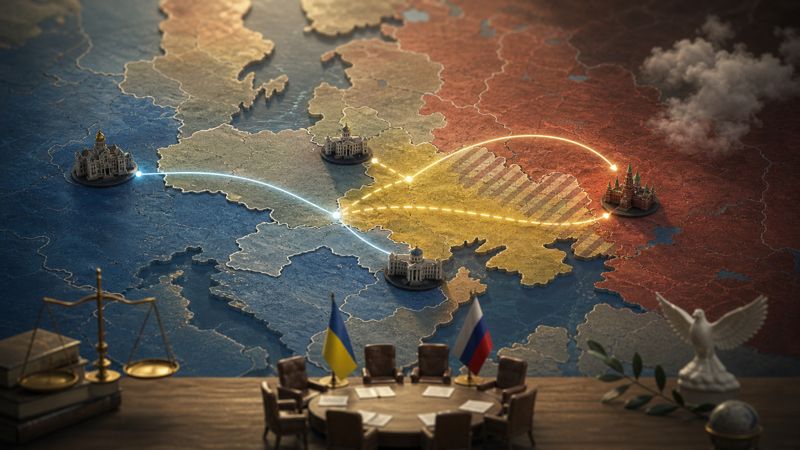
Variables to Monitor in 2026
- Western military and financial support continuity: Changes in US, EU, or NATO member support levels are among the most significant variables affecting Ukraine’s capacity to sustain current operations
- Russian domestic economic and political conditions: Sustained sanctions pressure and mobilisation costs create internal pressures that influence the Kremlin’s calculus on negotiation
- China’s diplomatic role: Beijing has positioned itself as a potential mediator while maintaining economic relationships with Moscow — any shift in China’s active engagement would be a significant signal
- European security architecture debates: Discussions around Ukraine’s NATO accession status, security guarantees, and EU membership pathways directly affect negotiating positions
- Battlefield developments: Any significant change in territorial control or operational tempo would reshape the probability distribution across all four scenarios
Why This Is Genuinely Hard to Predict
The Russia-Ukraine conflict has consistently defied prediction since February 2022. Early assessments that Kyiv would fall within days proved wrong. Later assessments that Ukrainian counteroffensives would produce decisive results proved overstated. The conflict’s trajectory has been shaped repeatedly by factors that were not visible to outside analysts — political decisions made in closed rooms, military capabilities revealed only in their use, and the actions of third parties responding to their own domestic pressures.
This opacity is not unique to this conflict — it is a feature of high-stakes geopolitical events generally. The variables that determine outcomes are often the least visible ones. This is precisely why prediction markets, which aggregate the views of many participants with diverse information sources, tend to produce more calibrated probability estimates than individual analyst forecasts in geopolitical domains.
See how collective forecasting reads the conflict
Nexory aggregates crowd-based expectations on geopolitical outcomes including the Russia-Ukraine conflict. Explore what the current collective probability distribution looks like.
Explore Geopolitical ForecastsConclusion
The Russia-Ukraine conflict is unlikely to reach a comprehensive resolution in 2026, but the conditions for a frozen conflict or negotiated ceasefire are more present than at any previous point in the war. Each scenario depends on a specific combination of conditions — and those conditions are shifting continuously.
The honest answer to “will the war end in 2026?” is: it depends on which variables move, in which direction, and on what timeline. A ceasefire requires mutual exhaustion plus a diplomatic framework. A peace settlement requires conditions that do not currently exist. A frozen conflict requires only that the high-intensity phase becomes unsustainable for both sides — which is the scenario requiring the fewest additional changes from the current situation.
Monitoring the key variables — Western support levels, Chinese diplomatic engagement, Russian domestic conditions, and battlefield realities — is more useful than accepting any single prediction. The uncertainty is genuine, and it should be treated as such.