Croatia World Cup 2026 Prediction: Modrić’s Last Dance and How Far Vatreni Can Go
Last updated: June 2026 · 8 min read
Croatia have become one of international football’s most consistent overachievers. A country of under four million people has reached two consecutive World Cup finals — finishing runners-up in 2018 and bronze medallists in 2022. In 2026, the question is not whether Croatia belong at the tournament. It is whether Zlatko Dalić’s side can produce one final deep run before a generational transition becomes unavoidable.
This Croatia World Cup 2026 prediction examines the squad strengths and vulnerabilities, Luka Modrić’s role at 40, Joško Gvardiol’s importance to the defensive structure, realistic tournament scenarios, and what would need to be true for Vatreni to reach the latter stages.
For a broader overview of how the tournament is shaping up, see our guide on 2026 World Cup favourites and what prediction markets actually say.
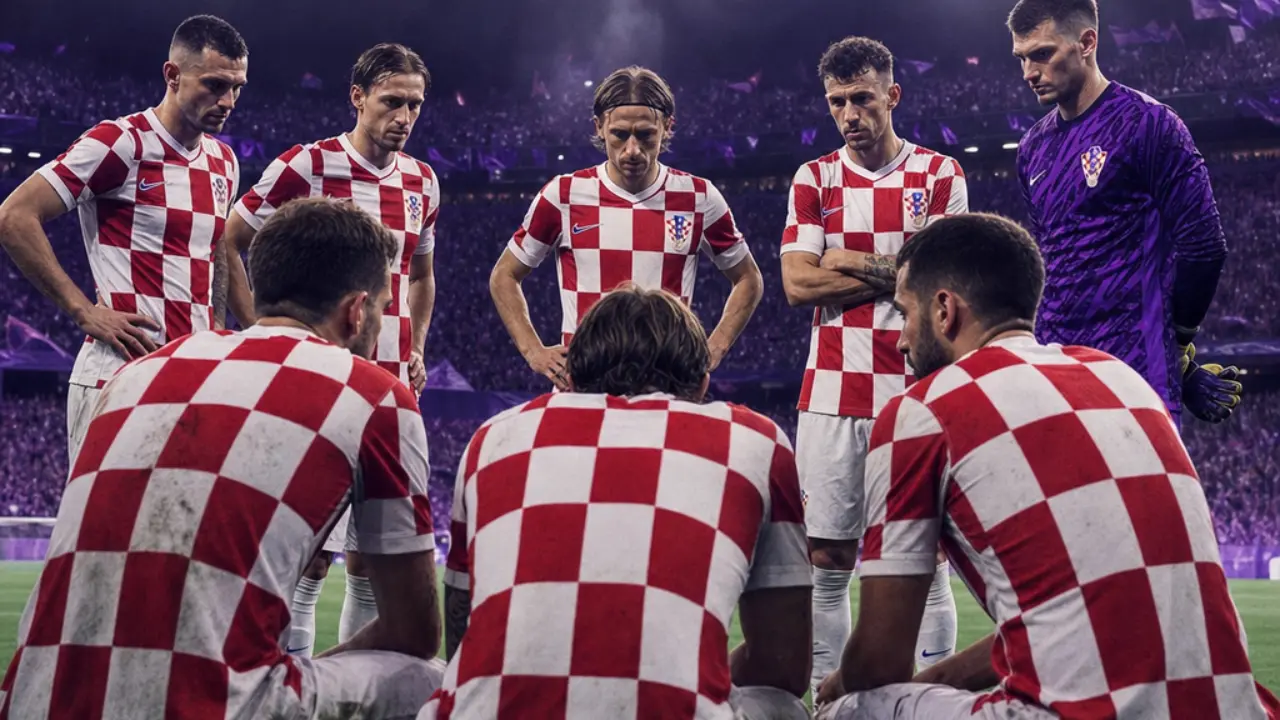
Quick Answer
Croatia are realistic quarter-final contenders in 2026. Their defensive organisation, midfield experience, and tournament intelligence make them capable of advancing through the knockout rounds — but their lack of a world-class striker and Modrić’s age introduce genuine uncertainty. A semi-final run is possible; a group exit would be a significant surprise.
Croatia’s Tournament Record: Why the Pattern Matters
Croatia’s recent World Cup record is unusual at this level. In 2018, they eliminated Denmark, Russia, and England before losing to France in the final. In 2022, they eliminated Japan and Brazil in the knockout stage before losing to Argentina and then beating Morocco for third place.
The consistent thread across both tournaments is an ability to raise performance under knockout pressure. Croatia have repeatedly beaten teams that were statistically favoured or physically superior. That pattern is not accidental — it reflects a tactical identity built around defensive compactness, midfield control, and the ability to win through moments rather than sustained dominance.
Whether that identity can persist without the generational core that has sustained it for a decade is the central question of the 2026 tournament for this squad. For context on how upsets typically emerge at this tournament, see our piece on World Cup 2026 upset predictions and which teams could surprise.
Luka Modrić at 40: Role, Influence, and What to Expect
Luka Modrić turns 41 in September 2026. He will be one of the oldest outfield players to have featured at a World Cup at this level of competitive relevance. The question is not simply whether he can still perform — his 2022 performances showed he remained effective — but whether his role has evolved to match his physical profile.
Modrić has historically been Croatia’s tempo controller: the player who dictates rhythm, breaks pressure through dribbling, and opens space for others to exploit. At 40, the expectation should be adjusted. He is likely to play fewer minutes per match, concentrate energy into high-value moments, and function more as a structural anchor than a high-energy presser.
That adjustment matters because Croatia’s system is built partly around his ability to retain the ball under pressure. If Modrić can maintain positional intelligence while reducing physical output — as some experienced midfielders have managed — Croatia’s midfield control should remain competitive. If fatigue becomes a visible factor in extended knockout matches, it creates a gap that the current squad may not fully cover.
Mateo Kovačić, now at his physical peak at 31, is increasingly the player who carries the engine work — pressing, recovering, and driving forward — while Modrić focuses on decision-making and retention. That balance, if it holds, gives Croatia a functional midfield even if Modrić’s direct contribution decreases.
Gvardiol and the Defensive Foundation
If Modrić represents Croatia’s past, Joško Gvardiol represents their future. The Manchester City centre-back has emerged as one of the top defenders in European club football, combining aerial dominance, aggressive positioning, and the ability to carry the ball out from the back into midfield transitions.
At 22, Gvardiol is playing at a level where his performance ceiling is still unclear. For Croatia’s 2026 campaign, his role extends beyond defending. A high-quality centre-back who can step into midfield and carry the ball reduces the load on Modrić and Kovačić in build-up phases. It also makes Croatia harder to press high, because the ball can move cleanly from defence without requiring a long ball sacrifice.
The broader defensive unit — typically a compact 4-3-3 or 4-2-3-1 depending on the opponent — is organised and difficult to break down quickly. Croatia’s defensive record across the 2018 and 2022 tournaments was among the better ones for teams that reached the latter stages, which reflects both individual quality and collective structure.
Attacking Concerns: Where Croatia Face Genuine Uncertainty
Croatia’s consistent limitation across recent tournaments has been converting quality into goals. They are a team that controls matches effectively and limits opponent opportunities, but their attacking output relative to their midfield quality has often been modest.
Andrej Kramarić remains the focal point — a technically capable forward who can link play and score from inside the box, but who is not a consistently dominant number nine at the highest level. Ivan Perišić’s international career is effectively at its end, removing the most reliable source of wide creativity Croatia have had for a decade.
That profile makes them dangerous in tight knockout matches but potentially vulnerable against teams that press high and force Croatia into sustained attacking solutions they may not consistently have.
The 48-Team Format: How It Changes Croatia’s Path
The expanded 48-team format at the 2026 World Cup introduces a Round of 32 that did not exist in previous editions. For Croatia, this creates both opportunity and additional load. More matches to win means more recovery demand across a longer campaign — a factor that matters more for a squad with older key players.
The positive implication is that weaker group opponents and an earlier knockout round against a third-placed team may provide a more manageable path to the quarter-finals. For a full breakdown of how the new structure reshapes tournament paths, see our analysis of the 48-team World Cup 2026 format and what it changes.
Croatia World Cup 2026 Prediction: Three Scenarios
Base Case — Quarter-Final Exit
Croatia advance from the group stage, navigate the Round of 32, and reach the quarter-finals. They compete closely before losing to a higher-ranked opponent. Modrić performs at a reduced but still effective level. Gvardiol anchors the defence. The attackers manage enough output to progress through knockout matches decided by fine margins. This scenario reflects Croatia’s historical pattern — deep runs without necessarily having the outright quality to go all the way.
Optimistic Case — Semi-Final Appearance
Croatia reach the semi-finals with a favourable bracket path, Modrić performing above physical expectations, and at least one younger attacker stepping up decisively. A semi-final would be consistent with Croatia’s prior results — they were there in 2018 — and is plausible if several conditions align. This scenario requires Croatia to avoid the tournament’s two or three strongest sides until late in the bracket.
Pessimistic Case — Round of 16 or Group Exit
Modrić struggles with the physical demands of tournament football, the attacking unit fails to produce in key matches, and Croatia exit before the quarter-finals. This is a lower-probability scenario given their track record, but not implausible if fitness problems compound across a longer campaign.
Follow Football Forecasts
Explore World Cup 2026 Predictions on Nexory
See how collective forecasting is pricing Croatia’s chances — and explore prediction markets across every major World Cup outcome.
Explore World Cup PredictionsKey Factors to Watch
Modrić’s fitness across a long tournament is the single most important variable. If he remains available and effective for knockout matches, Croatia’s midfield is capable at this level. If injury or fatigue forces him out early, the creative burden falls on Kovačić alone.
Gvardiol’s form matters differently — he is Croatia’s most important player for the next decade. A strong 2026 performance would reinforce Croatia’s transition to a post-Modrić era, even if the overall campaign falls short.
Penalty shootout resilience has historically favoured Croatia — wins on penalties against Denmark, Russia in 2018 and Japan in 2022. In tight knockout matches, that track record is not irrelevant to a probability assessment. For a wider view of knockout dynamics, see our World Cup 2026 knockout stage predictions.
How Prediction Markets Are Reading Croatia
Prediction markets typically price Croatia as a mid-tier contender — above teams expected to exit in the group stage or Round of 32, but well below the outright title favourites. This pricing reflects the dual reality of Croatia’s profile: proven knockout quality combined with genuine question marks about squad depth and physical ceiling in 2026.
Markets have historically underpriced Croatia’s tournament performance. Both 2018 and 2022 saw them outperform pre-tournament odds. Whether that pattern holds in 2026 depends largely on Modrić’s physical condition and whether younger players can step into decisive moments. For broader context, see our analysis of the 2026 World Cup favourites and the knockout stage prediction breakdown.
Frequently Asked Questions
Will Croatia reach the quarter-finals at World Cup 2026?
Based on historical performance and current squad quality, a quarter-final appearance is Croatia’s most likely deep result. They have reached at least the quarter-finals in both 2018 and 2022 and carry a structural identity that supports knockout resilience.
Is this Luka Modrić’s last World Cup?
Almost certainly. Modrić turns 41 in September 2026. While he has continued performing at club level beyond most expectations, the physical demands of a summer tournament at 40 make it highly unlikely he will feature at a 2030 World Cup.
Who are Croatia’s most important players at World Cup 2026?
Luka Modrić remains the identity figure, but Mateo Kovačić is likely the engine in terms of physical output. Joško Gvardiol is arguably the most important player for Croatian football’s long-term future and provides the defensive foundation that allows Croatia’s system to function.
Can Croatia win the World Cup in 2026?
It would require an exceptional combination of form, fitness, bracket fortune, and performance above historical norms. Croatia are not among the outright favourites, but their tournament record means they should not be dismissed as incapable of a deep run if conditions align.
How does Croatia typically perform in knockout matches?
Croatia have a strong knockout record — they won four consecutive knockout matches in 2018 (including three via extra time or penalties) and eliminated Japan and Brazil in 2022. Their defensive structure and composure in tight matches has consistently been a tournament strength.