India-Pakistan Conflict Risk 2026: Escalation, De-escalation, and What Comes Next
Last updated: June 2026 · 9 min read
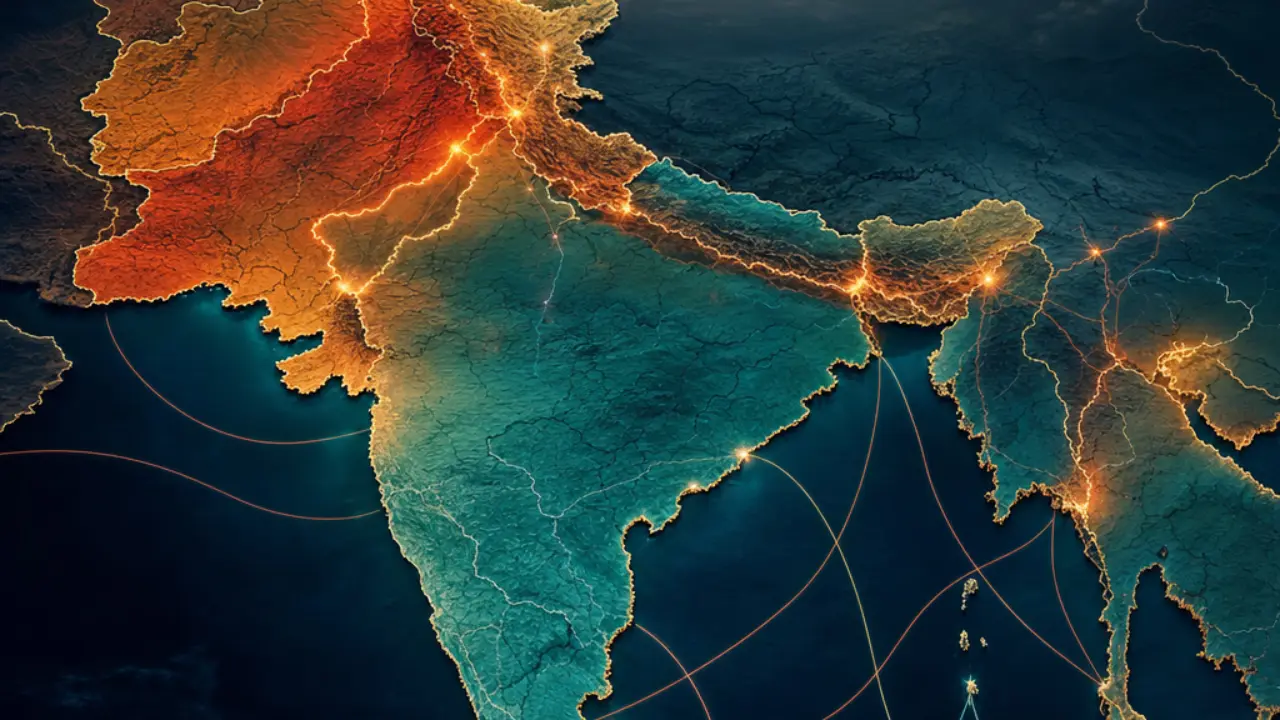
In May 2026, the Indian military launched Operation Sindoor — a series of precision strikes on targets in Pakistan-administered Kashmir and Pakistani territory, in response to a terrorist attack that India attributed to Pakistan-based militant groups. The operation triggered the most serious India-Pakistan military confrontation in decades, raising immediate questions about escalation risk and the durability of any de-escalation.
Both countries are nuclear-armed. The stakes of miscalculation are unusually high. This article examines what happened, the three main scenarios for where the situation goes from here, and how forecasters and prediction markets are assessing the risk.

Quick Answer
India-Pakistan conflict risk in 2026 is elevated but not at maximum. Operation Sindoor triggered a serious military confrontation, but both sides have strong incentives to avoid full-scale war. The most likely near-term scenario is a managed de-escalation with underlying tensions unresolved. A return to large-scale hostilities cannot be excluded, but most forecasters assign it a lower probability than a fragile ceasefire holding.
What Happened: Operation Sindoor in Context
Operation Sindoor was India’s most significant cross-border military action against Pakistan in the modern era. The strikes targeted what Indian authorities described as terrorist infrastructure — camps, logistics nodes, and command facilities used by groups operating in Jammu and Kashmir. India framed the operation as a targeted counterterrorism response, not an act of war.
Pakistan’s government condemned the strikes as an act of aggression and conducted retaliatory fire along the Line of Control. The Pakistani military went to a heightened alert posture. Diplomatic communications between the two countries effectively broke down in the immediate aftermath, with both sides recalling ambassadors and suspending bilateral channels.
International reaction was swift. The United States, China, and Gulf states called for de-escalation. The UN Security Council met in emergency session. Both Washington and Beijing — with competing interests in the region — applied pressure through separate diplomatic channels to prevent the confrontation from expanding.
The Nuclear Dimension
What makes India-Pakistan confrontations uniquely dangerous is the nuclear backdrop. Both countries possess nuclear arsenals and have doctrines that allow for their use under specific conditions. Pakistan’s doctrine is considered more permissive — it does not have a no-first-use policy, and some versions of its strategic thinking envisage nuclear use in response to large-scale conventional military defeats.
This does not mean nuclear use is likely. The historical record of nuclear-armed states in conflict shows strong deterrence effects. But it does mean that escalation ladders are shorter, that miscommunication carries higher stakes, and that both sides have strong incentives to manage crises before they reach thresholds that trigger irreversible decisions.
Three Scenarios for 2026 and Beyond
Scenario 1: Managed De-escalation (Most Likely)
International pressure — particularly from the US and China — produces a mutual stand-down. Both sides pull back from heightened alert postures. A de facto ceasefire along the Line of Control is restored. Diplomatic channels are gradually re-established, though formal relations remain suspended. The underlying causes — Pakistani-based militant networks, disputed Kashmir — are not resolved, and the risk of a future confrontation remains high. This is the scenario that most forecasters currently consider most probable.
Scenario 2: Frozen Conflict with Periodic Flare-ups
De-escalation occurs but is shallow. Military postures remain elevated. Exchanges along the Line of Control continue at higher-than-normal frequency. Neither side seeks full-scale war but neither returns to pre-Operation Sindoor normalcy. The conflict becomes a managed frozen dispute — similar to the post-Kargil pattern — with persistent risk of re-escalation. This scenario has significant implications for regional stability and for both countries’ economic trajectories.
Scenario 3: Escalation to Conventional War
A triggering event — another major terrorist attack attributed to Pakistan, a Pakistani airstrike that causes significant Indian casualties, or a political crisis that removes domestic constraints on either side — leads to full-scale conventional military operations. This scenario is considered significantly less probable than the first two but cannot be excluded. Its consequences would be catastrophic regardless of whether nuclear weapons are involved, and would reshape the regional and global strategic landscape.
What Prediction Markets Are Pricing
Prediction markets tracking India-Pakistan escalation risk moved sharply in May 2026. Probabilities for “significant armed conflict between India and Pakistan within 12 months” rose from low single digits to above 30% at the peak of the confrontation. As diplomatic pressure mounted and early de-escalation signals emerged, those probabilities began to decline — but remained elevated relative to pre-Operation Sindoor baselines.
The pattern reflects a key feature of how prediction markets handle geopolitical shocks — they update quickly on new information and tend to overshoot in both directions during fast-moving crises. The initial spike likely overpriced the short-term escalation risk; the subsequent decline likely reflects genuine progress on de-escalation rather than wishful thinking.
Broader markets also reacted. Indian equities sold off sharply in the days following Operation Sindoor, with the Nifty 50 falling several percent before recovering as de-escalation signals strengthened. The rupee weakened. Pakistani markets were more severely affected given the country’s more fragile economic position. Commodity markets — particularly oil — showed modest reactions given South Asia’s geographic distance from major supply routes.
Key Factors That Will Determine the Outcome
Factors to Watch
- Another major terrorist attack — a repeat of the trigger event would dramatically increase escalation probability
- US-China coordination — whether Washington and Beijing can maintain aligned pressure for de-escalation, despite their own US-China strategic competition
- Pakistani domestic politics — civilian control of the military and political stability in Islamabad affect decision-making unpredictability
- Indian election cycle — domestic political pressures on the Modi government affect the space for compromise
- IMF and economic pressure on Pakistan — Pakistan’s fiscal fragility creates incentives to de-escalate (war would be catastrophic economically) but also potential instability
- Ceasefire verification — whether any de-escalation agreement includes monitoring mechanisms that reduce the risk of miscalculation
Follow Geopolitical Risk
Track South Asia and Global Risk Forecasts on Nexory
Nexory’s prediction markets show how collective expectations shift as geopolitical crises unfold — from Operation Sindoor to broader regional escalation scenarios.
Explore Geopolitical PredictionsConclusion: High Stakes, Uncertain Trajectory
Operation Sindoor marked a significant escalation in India-Pakistan tensions but did not produce a full-scale war. The most probable near-term outcome remains managed de-escalation under international pressure. But the structural conditions that produced the confrontation — Pakistani-based militant networks, the unresolved Kashmir dispute, domestic political pressures on both sides — have not changed.
What has changed is the established precedent: India has demonstrated willingness to conduct cross-border strikes in response to terrorist attacks. This changes the strategic calculus for both sides and raises the baseline risk of future confrontations. Forecasters and markets will be watching closely for signs of whether de-escalation produces genuine stabilisation or simply a temporary pause.
Frequently Asked Questions
What was Operation Sindoor?
Operation Sindoor was an Indian military operation in May 2026 involving precision strikes on targets in Pakistan-administered Kashmir and Pakistan, described by India as counterterrorism action against militant infrastructure. It triggered the most serious India-Pakistan military confrontation in decades.
Is India and Pakistan at war in 2026?
As of mid-2026, both countries have not entered full-scale conventional war. Operation Sindoor triggered a serious military confrontation and exchange of fire along the Line of Control, but international diplomatic pressure has pushed both sides toward de-escalation. The situation remains tense with elevated risk.
What is the nuclear risk in the India-Pakistan conflict?
Both India and Pakistan are nuclear-armed states. Pakistan does not have a no-first-use policy and its doctrine allows for nuclear use under conditions of significant conventional military defeat. This makes full-scale conventional war extremely dangerous, which is one reason both sides have strong incentives to de-escalate before reaching that threshold.
How did financial markets react to the India-Pakistan conflict?
Indian equities sold off and the rupee weakened in the immediate aftermath of Operation Sindoor. Pakistani markets were more severely affected. As de-escalation signals emerged, markets partially recovered. The global impact was limited given South Asia’s distance from major commodity supply routes, though broader risk sentiment was affected.
What do prediction markets say about India-Pakistan war risk in 2026?
At the peak of the May 2026 confrontation, prediction market probabilities for significant armed conflict within 12 months rose above 30%. As de-escalation pressure mounted, those probabilities declined but remained elevated relative to pre-Operation Sindoor baselines — reflecting genuine uncertainty about whether the de-escalation will hold.