World Cup 2026 Final Prediction: Which Teams Could Meet in the Decider?
Last updated: June 2026 · 9 min read
The 2026 FIFA World Cup has begun. Forty-eight nations are competing across the United States, Canada, and Mexico in the most expanded edition of the tournament in history. Group stage matches are already under way — but the defining question for forecasters is already forming: which two teams will meet in the final on July 19 in New York?
Reaching the final in 2026 is harder than in any previous edition. The expanded format means non-host nations must win seven matches across a six-week period. That creates more opportunity for fatigue, injury, and bracket variance. At the same time, prediction markets have formed relatively clear expectations about which squads have the depth and tactical consistency to go the distance.
This article looks at the most likely finalists, the key scenarios markets are pricing, and what could disrupt the favourites between now and July 19.
Quick Answer
Spain and France are the most likely finalists according to current prediction markets. Spain lead tournament winner odds at around 17% implied probability, with France close behind at 16%. England, Brazil, and Argentina represent the next tier of contenders. The 48-team format creates longer, more unpredictable paths — and bracket variance could push an outsider into the final.
Why Reaching the Final Is Harder in 2026
The 2026 World Cup is the first to feature 48 nations across 12 groups. This changes the route to the final significantly. Teams must now survive a Round of 32 before reaching the quarter-finals — adding an extra knockout match that did not exist in previous editions.
For a non-host nation, the path runs: three group stage matches, Round of 32, Round of 16, quarter-final, semi-final, and final — seven matches in total. That is the same number as in previous tournaments but across tighter scheduling windows and greater travel distances.
Squad depth matters more in 2026 than at any previous edition. Teams that rely on a narrow group of key players carry greater injury risk. For a detailed breakdown of how the 48-team format reshapes tournament paths, the structural changes are worth understanding before assessing any finalist scenario.
The Leading Contenders
Spain
Spain enter the 2026 World Cup as the market’s leading finalist candidate. Their implied probability of winning the tournament sits at around 17%, ahead of any other nation. The basis for this assessment is clear: Spain are the reigning European champions, they play a possession-based style that tends to control tournament tempo, and they have one of the most technically complete squads in the field.
Lamine Yamal, still only 18, has emerged as one of the most influential players at international level. His combination of dribbling ability, positional intelligence, and decisive contributions in big matches gives Spain a generational threat on the right side that most defences will struggle to contain across multiple knockout rounds.
Spain’s main risk is not quality — it is whether their style can absorb high defensive pressure in late knockout matches when opponents are prepared to deny space and frustrate possession. Tournament football often becomes more physical and direct from the quarter-finals onward.
France
France are the second-ranked team in prediction markets at around 16% implied probability. Their case for the final rests on individual quality across every position: Kylian Mbappé at the apex of the attack, a physically dominant midfield, and one of the best defensive units in the tournament.
A 2–1 friendly loss to Ivory Coast in early June created some pre-tournament uncertainty. Markets moved slightly in response, with Spain edging into first place. Whether that result reflects a genuine issue or was simply an inconsequential warm-up fixture will become clearer once France play meaningful group stage matches.
France’s deeper concern is consistency across a full seven-match campaign. They have the talent to beat anyone on their day — but the World Cup requires performing across a sustained period, and France have sometimes shown inconsistency between group stage and deep knockout performances. France’s full tournament outlook examines the scenarios in more detail.
England
England enter at around +650 in tournament winner odds — behind Spain and France but ahead of the remaining field. They have one of the most complete squads in recent memory: Harry Kane as the central striker, Bellingham controlling midfield, Saka and Gordon as attacking wide options, and a solid defensive unit.
England’s historical pattern at major tournaments remains a point of uncertainty. They have reached two consecutive European Championship finals but converted neither. Whether 2026 represents a genuine title run or another near-miss is a question prediction markets are currently pricing as possible but not the most likely outcome. For a deeper look, England’s World Cup 2026 scenarios are examined separately.
Brazil
Brazil are the strongest non-European contender at around +850. Five World Cup titles but none since 2002 gives their 2026 campaign a mix of expectation and historical weight. Vinícius Júnior is their central attacking threat and one of the most dangerous players in the tournament.
Brazil’s main concern entering 2026 is tactical organisation under pressure. Their attacking players are elite, but recent knockout-round performances have included defensive lapses at key moments. A Brazil final run is plausible — it would require their structure to hold when their attack is contained by a well-organised opponent.
Argentina
Argentina are the defending champions, entering at around +1000. Seven analyst ballots included Argentina as a deep-run contender in pre-tournament coverage — but not a single one picked them to win outright. That gap between “likely to go deep” and “likely to win” is itself a meaningful market signal.
The Argentina case centres on Messi and the tight team structure that won in Qatar. Whether that unit can sustain peak performance through another seven-match tournament, with Messi now 38, is the central uncertainty. A full analysis of Argentina’s title defence scenarios looks at the structural factors in depth.
Three Final Scenarios
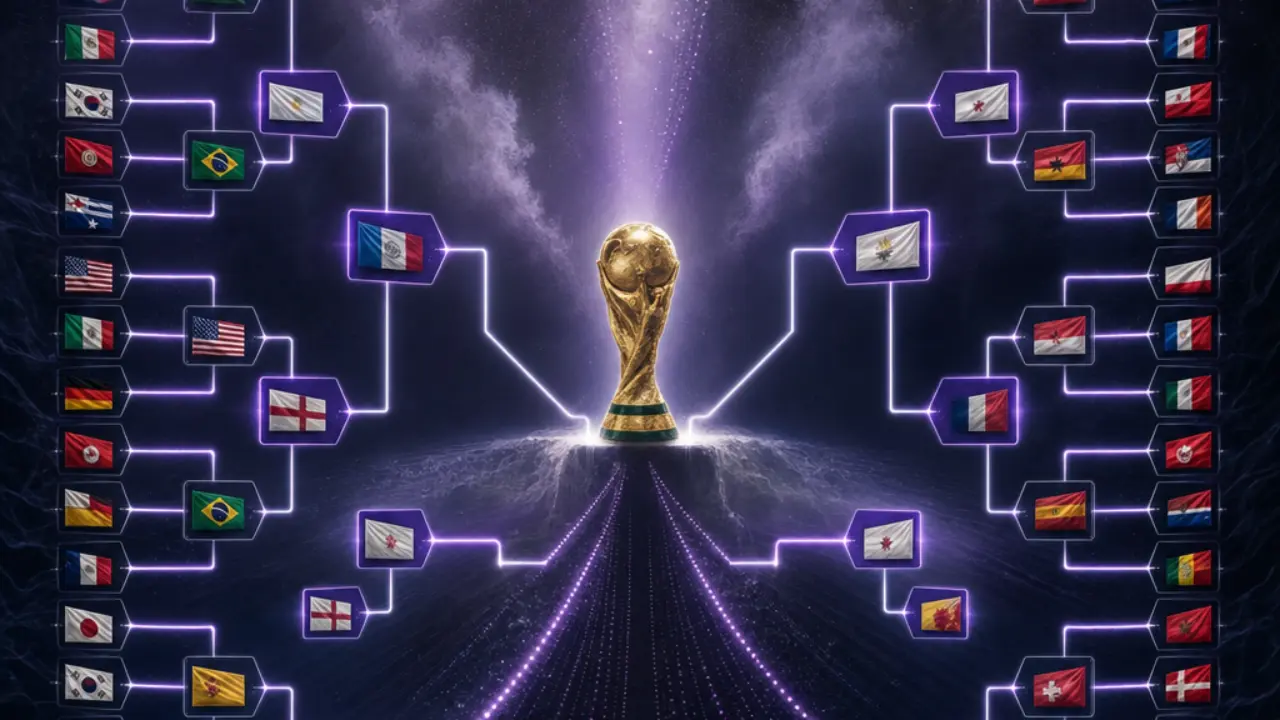
Scenario 1: Spain vs France
This is the most market-expected final matchup given current probability distribution. Both squads have the depth, tactical structure, and knockout-round pedigree to sustain a run through seven matches. A Spain vs France final would be a contest of possession and pressing styles — with a potential Mbappé vs Yamal storyline defining the individual narrative.
The main obstacle to this scenario is bracket placement. Spain and France could potentially meet before the final — in a semi-final, for example — which would remove one from the decider entirely. Bracket draw is a meaningful variable in any final prediction.
Scenario 2: Spain vs Argentina
Several pre-tournament analysts predicted a Spain vs Argentina final, with Spain winning. This scenario would carry a compelling narrative: the reigning European champion against the reigning World Cup champion, with Messi and Yamal on opposite sides of the pitch.
For this scenario to materialise, Argentina would need to navigate a demanding knockout path — potentially including a match against Brazil in the quarter-finals, which many forecasters view as likely depending on group placement. That would represent a significant test before a potential final.
Scenario 3: An Outsider Reaches the Final
The 48-team format increases variance throughout the bracket. In a larger, more unpredictable tournament structure, a team outside the top three — Portugal, Germany, England, or a genuine dark horse — could reach the final in a way that would have been statistically less likely in the 32-team format.
Portugal’s squad depth and Ronaldo’s tournament experience, Germany’s rebuilt attacking structure, and England’s overall quality all make them credible finalists in specific bracket scenarios. For a broader picture of which teams could cause surprise runs, the knockout stage path analysis examines bracket variance in detail.
What Prediction Markets Are Saying
Prediction markets are useful here not because they produce certainties — they don’t — but because they aggregate the views of many forecasters into a single probability estimate that reflects the collective assessment of the available information.
Platforms like Kalshi and Polymarket have already generated over $4 million in combined volume on World Cup winner markets, reflecting significant engagement with tournament outcomes. Spain sit at approximately 17% implied probability of winning the tournament, France at 16%. The remaining 67% is distributed across the field — primarily England, Brazil, Argentina, Portugal, and Germany.
What that distribution says is straightforward: even the tournament favourite is expected to not win the title roughly five times out of six. That is consistent with the historical variance of major football tournaments. For context on how prediction markets work in sports forecasting, the mechanism behind these probability estimates explains why market prices shift as the tournament progresses.
Follow World Cup 2026 Forecasts
Explore World Cup 2026 Predictions on Nexory
Track which teams prediction markets favour to reach the final and explore real-world outcome forecasts on Nexory.
Explore World Cup PredictionsKey Risks That Could Reshape the Path
Any World Cup final prediction made on day one of the tournament carries significant uncertainty. Several factors could substantially change which teams are in contention by the semi-final stage.
Injury to key players. A tournament running over six weeks creates cumulative physical load. The loss of Mbappé, Yamal, Kane, or Vinícius would significantly alter their team’s finalist probability. Injury risk is difficult to price in advance but is historically one of the most common disruptors of pre-tournament forecasts.
Bracket collisions. If two top contenders are placed in the same half of the bracket, one will exit before the final. Spain and France meeting in the semi-final, for example, would remove one of the two market leaders from the decider regardless of performance.
Penalty shootouts. In knockout football, outcomes can swing on individual moments. A team that plays well across 120 minutes but loses a shootout exits the tournament — introducing a variance element that probability models cannot fully account for.
Group stage form and momentum. Group stage matches set psychological and tactical tone for the knockout rounds. A strong or weak opening phase can reshape a team’s confidence, fitness, and bracket seeding heading into the Round of 32.
Conclusion
The most likely 2026 World Cup final, based on current prediction market data, involves Spain and France — either against each other or each against a different finalist from the chasing group. England, Brazil, and Argentina represent credible alternatives who could displace one of the two market leaders through bracket variance, injury, or momentum shifts.
No prediction for a final held on July 19 carries high certainty on June 11. The value in framing these scenarios at the tournament’s start is not to produce a definitive answer — it is to understand which outcomes are more or less plausible, and to track how market expectations shift as group results come in and the knockout bracket takes shape.
For a broader view of the full tournament contenders and their probability distribution, see what prediction markets say about the 2026 World Cup favourites.
Frequently Asked Questions
Who are the favourites to reach the 2026 World Cup final?
Spain and France are the two teams prediction markets currently price as most likely to reach the final. Spain lead at around 17% implied probability of winning the tournament, with France close behind at 16%. England, Brazil, and Argentina represent the next tier of realistic contenders.
When is the 2026 World Cup final?
The 2026 FIFA World Cup final is scheduled for July 19, 2026, at MetLife Stadium in East Rutherford, New Jersey, near New York City.
Can Argentina reach the 2026 World Cup final as defending champions?
Argentina are a realistic finalist candidate, priced at around +1000 to win the tournament. Pre-tournament analysts widely expect them to go deep, but few picked them to win outright. Messi’s form and fitness over a seven-match campaign remain the central uncertainty in their title defence.
How does the 48-team format affect which teams reach the final?
The 48-team format adds a Round of 32, meaning finalists must win seven matches over six weeks. This places a greater premium on squad depth and fitness management, and increases bracket variance — creating more scenarios where a top contender is eliminated earlier than pre-tournament odds suggested.
What do prediction markets say about the World Cup 2026 final?
Prediction markets on Kalshi and Polymarket have generated over $4 million in combined volume on World Cup winner markets. Spain and France together account for around 33% combined probability, meaning markets give the rest of the field a two-in-three chance of producing a different finalist or winner than the current top two.