Which Geopolitical Outcomes Are Prediction Markets Watching Most Closely in 2026?

Which Geopolitical Outcomes Are Prediction Markets Watching Most Closely in 2026?
Category: Geopolitics | Reading time: ~8 min
Every year, analysts publish lists of geopolitical events to watch. Most of these lists reflect editorial judgment — the situations that appear most dramatic or most newsworthy to individual observers.
Prediction markets offer a different filter. The outcomes that attract the most participation, the widest probability distributions, and the most active price movement are the ones that informed forecasters collectively consider most consequential and most genuinely uncertain. These are not necessarily the most discussed events in mainstream media — they are the events where the outcome is materially undecided and where getting the forecast right has real implications. To understand how these markets form their probabilities, see what are prediction markets and how do they work.
This article examines the geopolitical outcomes drawing the highest collective forecasting attention in 2026 — what makes each one significant, what drives the uncertainty, and what signals to track as the year develops.
Quick Answer
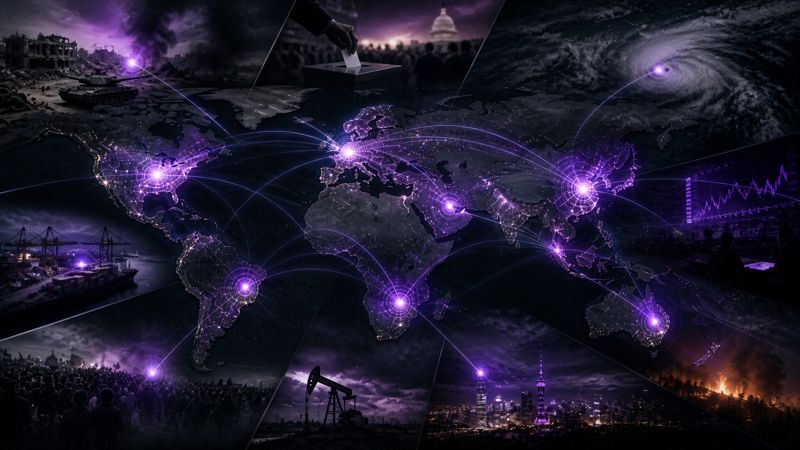
In 2026, the geopolitical outcomes attracting the most prediction market attention cluster around five areas: the trajectory of the Russia-Ukraine conflict, cross-strait tensions between China and Taiwan, Middle East regional stability, major election outcomes in key democracies, and the evolution of US-China trade and technology competition. These share a common characteristic: genuine uncertainty with high-stakes consequences across multiple dimensions.
Why Prediction Markets Are a Useful Filter
The volume of geopolitical events at any given time is vast. Identifying which ones genuinely matter — in terms of probability of significant change and scale of consequences — is itself an analytical challenge.
Prediction markets provide a useful filter because participation costs something. When participants allocate stakes to a specific outcome, they are revealing genuine conviction. Events that attract broad, active participation across many participants with diverse information sources are, by this logic, events where the uncertainty is real and the stakes are perceived as significant.
Conversely, events that generate media attention but attract thin prediction market participation tend to be either highly predictable (the outcome is already essentially known) or too vague to bet on (the resolution conditions are unclear). The filter self-selects for consequential, genuinely uncertain outcomes.
The Five Outcomes Drawing the Most Forecasting Attention
1. The Russia-Ukraine Conflict Trajectory
The conflict remains the single highest-participation geopolitical prediction market topic globally. What makes it compelling from a forecasting perspective is the breadth of genuinely uncertain sub-outcomes: Will a ceasefire emerge? Will Western support shift materially? Will front lines move significantly? Each sub-question carries a wide probability distribution, and those distributions are actively moving as conditions change.
What drives the uncertainty: The interaction of military capacity, political will, Western support levels, and Russian domestic conditions creates a multi-variable system that resists confident prediction. Small changes in any single variable can shift the overall probability distribution significantly.
Signal to watch: The state of US-Europe diplomatic coordination on support levels — any fracture here would be the single most significant variable shift in the near-term trajectory.
2. China-Taiwan Cross-Strait Developments
The China-Taiwan situation is among the most-watched long-horizon prediction market topics globally. Near-term conflict probability remains in the minority range for most forecasters, but the long-horizon probability distribution is notably wide — reflecting genuine disagreement among informed observers about the 5–10 year trajectory.
What drives the uncertainty: The combination of deliberate strategic ambiguity by all major actors, the semiconductor factor, US deterrence credibility questions, and the opacity of Chinese domestic political dynamics creates irreducible uncertainty that neither dismissal nor alarm can honestly resolve.
Signal to watch: PLA military exercise scope and frequency — the clearest publicly observable signal of operational preparation and political intent.
3. Middle East Regional Stability
The Middle East region contains multiple overlapping prediction market topics in 2026: the ongoing situation in Gaza and its humanitarian and political trajectory, the broader Iran-Israel dynamic and its escalation potential, and the question of whether any regional normalization processes continue. These are treated as related but distinct forecasting questions — movements in one affect the probability distributions in others.
What drives the uncertainty: The interlocking nature of the region’s security relationships means that developments in one arena rapidly affect others. Iranian nuclear programme signals, Saudi diplomatic positioning, and US engagement levels all interact in ways that make isolated predictions unreliable.
Signal to watch: Iranian nuclear programme status and any new international monitoring developments — this variable has the widest potential consequences for the regional stability distribution. The energy market implications of these tensions are explored in our analysis of how Middle East conflict affects oil prices.
4. Major Democratic Elections and Political Transitions
Several significant national elections are scheduled or expected across key democracies in 2026. Prediction markets assign particular weight to elections where the outcome would materially affect foreign policy positions on major active conflicts, trade relationships, or alliance structures. Electoral outcomes in Germany, France, and several emerging market democracies — including the Brazil election 2026 and Colombia election 2026 — are attracting notable forecasting attention in 2026. The November US midterm elections 2026 also carry significant weight given their potential impact on trade policy and foreign alliances.
What drives the uncertainty: Democratic elections are genuinely uncertain because voter preferences respond to real-world events in ways that are difficult to model months in advance. Economic conditions, candidate quality, and the salience of specific policy issues all shift between polling and election day.
Signal to watch: Coalition formation dynamics in European parliamentary systems — the translation from vote share to governing majority is often where the most consequential uncertainty lies.
5. US-China Trade and Technology Competition
The evolution of US-China competition across trade, semiconductor access, AI development, and critical supply chains is a prediction market topic with unusually broad economic implications. The specific outcomes being tracked include the scope and enforcement of semiconductor export controls, tariff trajectories, and whether any diplomatic de-escalation mechanisms emerge that would reduce the bifurcation of global technology infrastructure.
What drives the uncertainty: Policy decisions in this domain are made by a small number of senior officials responding to a complex mix of domestic political pressures, economic data, and security assessments. The direction of travel is clearer than the pace and specific form it takes — which is where prediction market price movement is most active.
Signal to watch: US chip export restriction enforcement actions and any Chinese retaliatory measures in critical minerals — these tangible policy moves shift probability distributions most directly. For a deeper look at the full range of these dynamics, see our article on US-China trade and technology competition in 2026.
What These Situations Have in Common
Shared Characteristics of High-Attention Prediction Market Topics
- Genuine uncertainty: The outcome is not already known or effectively determined — multiple scenarios remain plausible to informed observers
- High consequence: The outcome would materially affect financial markets, security architecture, or the wellbeing of large populations
- Observable signals: There are specific, trackable indicators that shift probability distributions — the uncertainty is structured, not random
- Clear resolution conditions: It is possible to define, in advance, what constitutes each outcome — preventing ambiguous resolution
- Active information environment: New information arrives regularly, keeping market prices dynamic and participation engaged
How to Use This Information
Understanding which geopolitical outcomes prediction markets are tracking most actively is useful in two ways. First, it provides a calibrated picture of where the real uncertainty lies in the global environment — as opposed to where media attention happens to be directed. Second, it identifies which developments, when they occur, are most likely to produce significant price movements across financial markets and other asset classes affected by geopolitical risk.
For investors, analysts, and anyone whose decisions are affected by geopolitical outcomes, the prediction market attention map is more useful than a media consumption map. Two of the most actively tracked situations are China and Taiwan and the Russia-Ukraine conflict and ceasefire scenarios. The events that markets are pricing intensely are the events where the outcome genuinely matters and is genuinely unknown — which is precisely where structured probability thinking adds the most value. The direct impact of geopolitical events on crypto market behaviour is examined in how crypto markets react to geopolitical events.
Beyond the Top Five: Additional Geopolitical Risks in 2026
Alongside the five primary clusters, several other geopolitical situations are generating meaningful prediction market activity in 2026:
- European defence spending in 2026 — NATO pressure and the Ukraine conflict are driving a structural shift in how European states allocate defence budgets, with implications for alliance cohesion and industrial capacity.
- Trump, NATO, and US alliance posture in 2026 — US commitment to NATO remains a live forecasting question, with direct consequences for European security architecture and deterrence credibility.
- India-Pakistan conflict risk in 2026 — Operation Sindoor in May 2026 triggered the most serious India-Pakistan military confrontation in decades, making this one of the most watched new escalation risks globally.
- North Korea in 2026 — missile testing cycles, Russia-North Korea military cooperation, and the state of US-DPRK relations continue to generate forecasting uncertainty in Northeast Asia.
- Syria after Assad’s fall — the post-Assad political transition remains fragile, with competing factions, regional powers, and the question of US and Turkish engagement all creating substantial uncertainty about the country’s trajectory.
See what geopolitical outcomes are currently being forecast
Nexory tracks collective expectations across major geopolitical events. Explore active forecasts and see where the probability distributions currently stand.
Explore Geopolitical ForecastsConclusion
The geopolitical outcomes that prediction markets track most closely in 2026 share a common profile: they are genuinely uncertain, consequential, observable through specific signals, and actively evolving. The Russia-Ukraine trajectory, the China-Taiwan dynamic, Middle East stability, key democratic elections, and US-China technology competition each meet this profile — which is why they attract the deepest and most active collective forecasting attention.
The value of this lens is not in providing answers. It is in providing a structured map of where the genuine uncertainty lies — and in focusing attention on the specific signals that will shift probability distributions as the year develops. In a world with no shortage of geopolitical noise, prediction markets offer a filter that prioritises signal over volume.